
Who wins? Who loses? Who grows? And who gets left behind?
The commercial landscape of the event medical industry is about to change.
With changes to CQC regulation coming in December 2027, my prediction is that the 2028 event season could mark the beginning of a very different market.
The playing field is changing
Right now, whether you are registered with the CQC or not doesn't necessarily make much difference commercially.
We still have registered and unregistered providers competing for the same contracts, and in many cases, the cheapest quote wins.
Why? Because in a market where the regulatory requirements haven't always been clear, it can be difficult for event organisers and SAGs to distinguish between providers in terms of their clinical competence, governance and the standards they operate to.
So, effectively, we're operating on a fairly level playing field, even though the providers competing on it may be very different in terms of their clinical competence, governance, leadership and investment.
But I think that's going to change.
We are seeing across the industry events, stadiums and TV production units making the decision to only buy medical services from a medical provider currently registered with the CQC. I have spoken to a few of them, and quite simply, in an ambiguous market with so many unanswered questions, they must look at the risks, and they are working on the basis of “better to be safe than sorry”.
Now, this is not by any stretch a majority stance across the market. However, it is happening.
From the 2028 event season onwards, as the new regulatory requirements take effect and organisers become more aware of what they should be looking for, I predict we'll start to see a very different commercial landscape.
The strongest providers will get stronger
As providers get better at positioning themselves commercially, while also developing strong governance and leadership models, I think we will see the playing field change.
As the saying goes, “Where focus goes, energy flows.”
And what I mean by that is the event medical industry is under the spotlight. Providers are working hard not only to market themselves as the best, but to be the best. Regulation has a way of doing that to a market. It raises expectations, encourages investment and, in my opinion, the strongest providers will get stronger.
I wouldn't be surprised if we see the top 1–5% of providers becoming increasingly dominant in the larger event medical market.
As those providers become stronger commercially and clinically, they will be able to invest more in their businesses. Better teams, better governance, better equipment and stronger leadership.
And the more they invest, the more competitive they become. They can win bigger contracts, generate more income and potentially take an even greater share of the market.
It's a cycle, and one that could leave those who think good is good enough struggling to compete.
And don't forget, no one's position in this market is guaranteed. One serious complaint, a poor inspection outcome or a drop in your CQC rating could have a significant impact on the contracts available to you.
You could find yourself competing for a much smaller part of the market than you were previously.
So, where does that leave everyone else?
Where do you want to position yourself on the triangle?
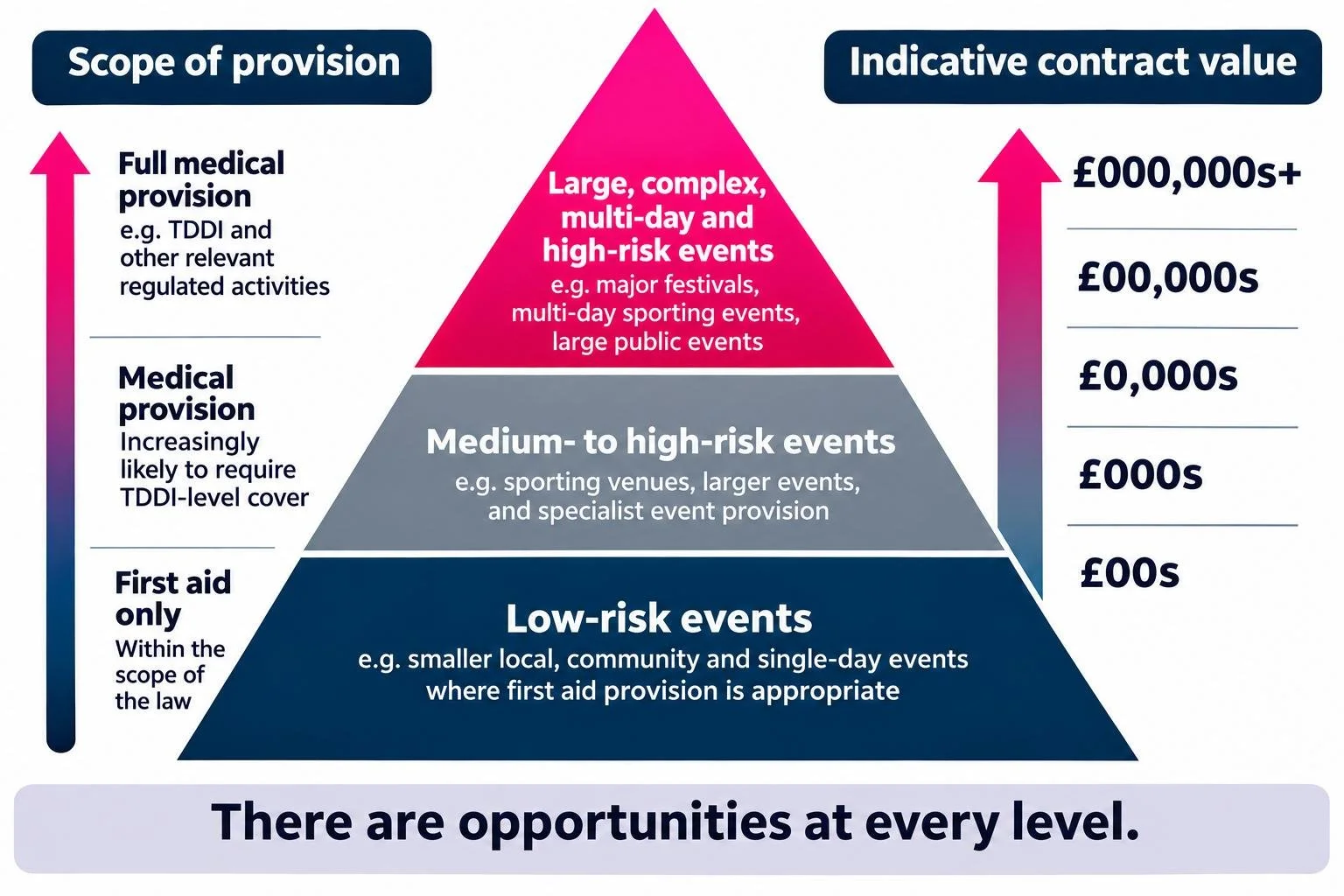
The commercial triangle
Which market do you want to operate in?
Let me explain my thinking from a commercial perspective in the market we find ourselves in currently and ask you a question that I think you can answer now about your business model and future.
What market are you operating in today?
and
What market do you want to be competing in three years from now?
In my opinion (and it is only my opinion), there is room for everyone.
If you want to stay unregistered, provide an unregulated service within the scope of the law (because this will be the law), then there is room for you.
There will be hundreds, if not thousands, of events where it is completely appropriate to have first aid only cover.
Commercially, you can position yourself in this tier, be the best in your field, build a great reputation, especially with local providers and teams, and fly. You can be commercially savvy in this space. There is a lot of opportunity.
You can also grow into the second tier, build a reputation as a dependable supplier, with good governance structures, providing exceptional first aid cover at events where the medical needs assessment and risk assessment identify this as appropriate.
But, and this is a big but, don't be one of the players who is looking to the grey area too much. Don't be stretching what you can and can't do as a first aid provider.
The CQC's definition of first aid, in summary, is:
First aid is the immediate response to a sudden illness, injury or deterioration in someone's condition. Its purpose is to preserve life, prevent deterioration, offer comfort and reassurance, and support the person until further help is available.
It is limited to generally recognised first aid procedures. It may include simple, non-invasive observations, but does not extend to clinical diagnosis, treatment requiring a registered healthcare professional's judgement, or ongoing healthcare management.
Source: CQC – Treatment of disease, disorder or injury: First aid
Stay in this lane, because if you stray too far from it and someone finds out, which, if something goes wrong, a complaint is made or if the SAG asks questions, could happen, you could be prosecuted.
And I don't just mean your company. I have examples where individuals have been prosecuted for providing care personally that they weren't governed for.
A limited company structure won't save you here.
Registering with the CQC
Now, let's move into the CQC-regulated options, because you don't have to register for both Treatment of Disease, Disorder or Injury (TDDI) and Transport Services, Triage and Medical Advice Provided Remotely.
There are two regulated activities to consider here, and you should be clear about what each cover. I'm not going into all of that for the purposes of this article. We're focusing on commercial opportunity and your business model.
Registering with the CQC for both activities provides you with the greatest commercial advantage within this space. It means you can quote and tender for probably most, if not all, of the opportunities available. (Whether you want to or not is something we'll come back to.)
Your CQC rating will also be important. If you want to position yourself in this market alongside other CQC-registered providers, there will be strong competition at this level.
Your CQC rating is publicly available for anyone to check on the CQC website, and we're already seeing tenders going out where organisers not only want you to be registered with the CQC but also to have a rating of Good or Outstanding.
I know, I know. The CQC have fallen behind on their inspections, and you may have a very outdated rating without having had the opportunity to showcase the improvements you've made.
Contact them and ask for an inspection. It's in your commercial interests to do so, and to do it as soon as possible. They may or may not be able to accommodate you within the timeframe you want, but ask anyway.
Commercially, the contracts available at this level are likely to be financially and operationally larger. But that doesn't mean every opportunity is right for your business.
You still need to know who you are, what you do best and where you want to position yourself in the market.
The niche within the niche: Who are you?
You don't have to compete for every contract available, and you don't have to be the biggest provider in the market to be commercially successful.
There are opportunities to build a reputation in a particular area, with a particular type of event or with a particular service. You might be brilliant at providing medical cover for sporting events, festivals, film and television productions, or smaller local events where you've built strong relationships and a reputation for doing what you do well.
And I think this is something providers should be thinking about now, rather than waiting to see how the market develops.
Being registered with the CQC may open more doors commercially, but it doesn't mean every door is the right one for you.
Don't wait for all the answers
I love how so many people are talking about the upcoming changes to regulation in the event medical industry. I have been talking about this for over a year now and seem to have found a lot of like-minded people on social media. I think this is great news for the industry and for us to see some consistency in healthcare provision at events.
I know there are a lot of unanswered questions. And a lot of those questions are unlikely to be answered ahead of the changes coming into force in December 2027. As we move through this process, we will find out more.
One of my new favourite quotes is:
“Go as far as you can see, and when you get there, you’ll be able to see further.” (Thomas Carlyle)
A good mantra for life in general, but especially in these times we are in. The risk is that if you wait for all the answers, you will likely leave yourself in a position where you are then spending a year or so catching up.
And that brings me back to the commercial question.
What market do you want to be competing in three years from now?
Because there are commercial opportunities at every level. You don't have to compete at the very top to build a successful business. But you do need to understand your market, know what you're good at and make some decisions about where you want to be.