
The CQC shouldn’t apply to event medical providers because we are different. Because we are specialist.
The problem is, so is everyone else.
A theme (I won’t say it was common) but it was a theme that ran through the CQC consultation analysis went something like this:
“CQC model is poorly suited to the event sector”
“…unlikely to improve patient outcomes”
“Unnecessary overreach”
“Another body should take responsibility for this – someone who understands us”
Of course you are different, you don’t have a whole hospital of specialist equipment, expertise and imaging when you are out in a field or on a mountain. You only have what is available to you in that moment.
Experience has told you what that needs to look like over time, and that is part of what makes you so specialist.
Pre-hospital emergency medicine may well deserve to be its own distinct speciality, but as things stand, it isn’t. Healthcare has specialisms within specialisms. Some are so specialist they even have their own hospitals.
So of course, there are many clinicians out there saying the exact same thing:
“You don’t understand our service. How can you regulate something you don’t understand?”
And I get it.
I have been there and got the T-shirt.
I tried to work out how many CQC inspections I was involved in throughout my career and I can’t. Because there were too many.
And I have absolutely sat there thinking:
“You don’t understand my service.”
“This isn’t going to work for us.”
And, on at least one occasion:
“You CANNOT be serious?!”
I think that was when someone suggested we write a care plan for every patient in ED.
But having been through the process more times than I can count, I think this is where we sometimes misunderstand what CQC is there to do.
They aren’t there to decide whether you are a good doctor or paramedic. They aren’t there to peer review every clinical decision you make or decide whether you have the clinical expertise to work in a field or halfway up a mountain.
CQC regulate the service
And that is a different function. Maybe it is helpful, in some ways to think of regulation as a speciality in itself.
They are interested in the whole system in which you provide that care. How do you know if patients are being treated safely? How do you manage medicines? What happens when something goes wrong? What do you learn from incidents or complaints? How do you know when people are competent? What records do you keep? Where do you keep them, how are they stored? How do you change things that aren’t working?
Or, based on my experience of CQC inspections: Show me. Show me how you know.
And none of those questions stop mattering because you are providing healthcare in a field rather than a hospital.
The process of change
Let us take a slight detour here into the world of organisational change.
The change curve was adapted from the work of the psychiatrist Elisabeth Kübler-Ross, she introduced the stages to describe how terminally ill patients process their reality. Over time, the model has been adapted and applied to the way people respond to major change at work.
I am telling you this because when I look at what I am hearing and seeing across the sector, a lot of it looks like a very normal human response to change. I think that is helpful to recognise.
When you are in the middle of a massive change, especially one you didn’t ask for and might not agree with, it can be difficult to imagine how you are going to feel about it, beyond the here and now.
So have a look at the curve. Where are you?
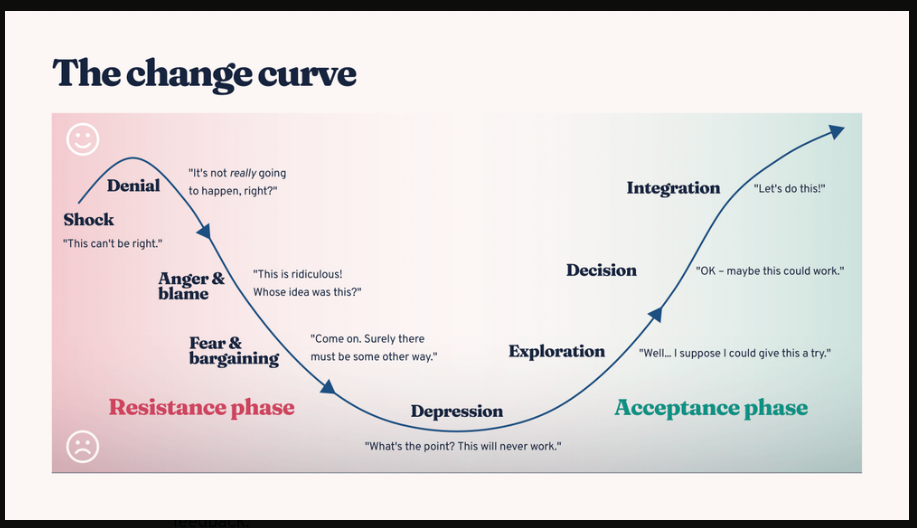
Change Curve
Wherever you are on the curve, your colleagues may be somewhere completely different and that’s normal too. Where you are now isn’t necessarily where you’ll end up.
Acceptance of the situation isn’t necessarily agreement.
At some point, you just have to decide what it means for you.
No Magic bullet
The CQC isn’t a magic bullet that is going to make everything right in the world of Pre-hospital Event Medicine and some of the criticism directed at the CQC is justified.
The argument that we are different on its own is unlikely to change the guidance or regulation at this stage in the process as we are here now.
You are different, you are specialist and what you do matters.
I don’t have a crystal ball to sit here and predict what unintended consequences may come out of all of this. I am not going to list those that were included in the consultation responses as they are there for people to read.
Maybe the question is what do we do with this uncertainty, what does the industry need to do together to help people understand what has changed and what it means for how we work in the future?
You don’t have to agree with the change, but at some point you are going to need to decide what the change means for you, your company or your event.